Ear Acupuncture Curbs Back Pain in Pregnant Women
October 18th, 2009 by Jill Blakeway, M.S. L. Ac.
This week I was interested to read a new study in the American Journal of Obstetrics and Gynecology which showed that ear acupuncture can significantly reduce low back and pelvic pain in pregnant women. You can read the full text of the study here. This is not the first research study to look at this. In fact in 2005 I was interviewed by ABC news about a previous study in the British Medical Journal that also showed acupuncture can help with pregnancy back pain. You can watch that clip here.
Up to 1 in 5 women suffer from back and pelvic girdle pain in pregnancy. Usually our patients complain of pain in
the low back and buttocks although some patients also feel discomfort at the front of their pelvic area. Some women also experience radiating pain down one or both of their legs. Most women tell us that the pain gets worse if they have to stand for a long time. In 7% of women the pain continues after they have given birth becoming a chronic lower back issue.
At the YinOva Center many of our pregnant patients are keen to avoid medication, if possible, and so they choose acupuncture as a gentle and safe way to treat their pain. We
usually use a combination of ear acupuncture as described in this recent study and local acupuncture as outlined in the previous study. The local acupuncture works in three ways – the needles act on the nervous system to interrupt the pain signal, the combination of needles causes the body to release chemicals which act as natural pain killers and by needling the spasms we get the knots in the muscles to release.
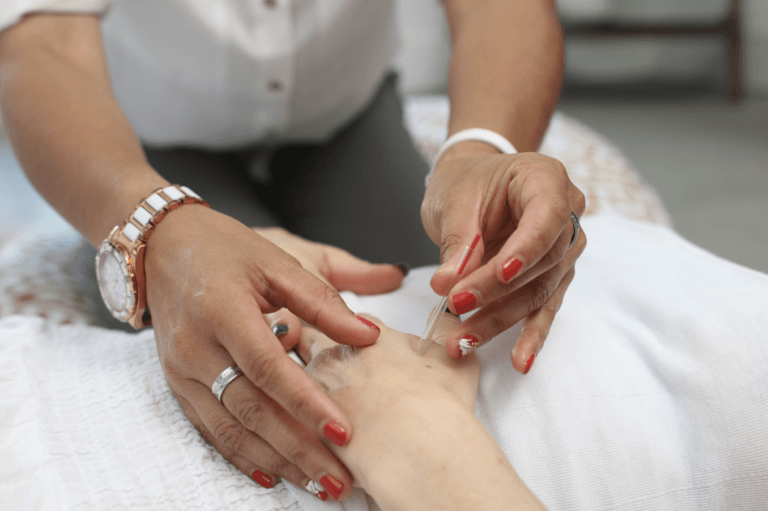
In the recent study the patients only received ear acupuncture which has a long history of efficacy in China
and has been found in clinical research to initiate an endorphin release. 152 women, in late pregnancy, were divided into three groups one of which had small acupuncture needles held in place by tape and retained in three ear acupoints for one week. Another group received sham acupuncture and the final group acted as a control and received no acupuncture at all although they were instructed to rest and take painkillers if necessary. 81% of women in the ear acupuncture group reported a significant reduction in pain as oppose to 59% of the women in the sham acupuncture group and 47% of the women in the control group.
Acupuncture is a time-tested therapy for pain relief and because it has few side effects is one of the safest ways of releiving pain in pregnant women. Most of our patients get relief from the combination of ear and body acupuncture and usually feel much better after 2 or 3 treatments. Other helpful treatments include gentle stretching exercises as well as massage by a qualified prenatal massage therapist and we usually suggest that women do one of these in conjunction with their acupuncture treatment.

Fragile X is a genetic disorder and is the most common cause of inherited mental impairment and cognitive problems including some forms of autism. It is caused by a mutation of the FMR1 gene on the X chromosome. The mutation turns off the production of the FMR1 protein which in turn affects brain development. People with Fragile X suffer from mental impairment which can take the form of anything from very minor learning difficulties to severe cognitive problems. They may be hyperactive or over sensitive to stimuli and they may have short attention spans. Physically people with Fragile X may have a long narrow face, prominent ears, enlarged testicles and loose joints. Approximately 1 in 2000 boys suffer some kind of mental impairment due to Fragile X. The disorder also affects girls but the incidence is lower and the symptoms tend to be milder. This is because girls have 2 copies of the X chromosome whereas boys only have one. This means that girls have 2 copies of the FMR1 gene so if one is mutated a girl has another copy of the gene to fall back on. Boys only have one X chromosome.
Fragile X syndrome is carried on the X chromosome. Since men (XY) and women (XX) each have at least one X chromosome, both parents can be carriers.
If a mother is the carrier, she can pass the gene defect to either her sons or her daughters, since she contributes an X chromosome to each. If, as a woman, you are a carrier you have a 50% chance of passing the gene on because you have two X chromosomes and only one of them is affected. So if you are a carrier you may not pass on the defect at all or you may just pass on the premutation or your child could inherit the full syndrome. Sons who have fragile X are at high risk of intellectual disability but daughters who receive the fragile X gene may appear normal because the have two X chromosomes and only one is affected.
A simple blood test can establish if you are a carrier of Fragile X and the degree to which this mutation is likely to cause problems for your child. Geneticists classify the gene mutation into three categories based on the number of repeats of a pattern of DNA called CGG repeats. Individuals with less than 60 CGG repeats have a normal gene. Individuals with 60-200 CGG repeats have a premutation which means they do have a small risk of their child suffering from Fragile X syndrome and that risk is directly related to the number of CGG repeats. Parents with over 200 repeats have a full mutation which causes fragile X syndrome.
As for my patient. She fell into the middle ground in that she had the premutation and so was at a small risk of passing on Fragile X. Fortunately we live in a time when we have access to good genetic testing and advice. Her doctor was able to reassure her that, because the number of CGG repeats was low her risk of passing this disorder on to her child was minimal. An amniocentesis at 16 weeks was able to confirm her doctor’s prediction and she was relieved to hear that her baby was just fine.
I’m very excited today. It is my daughter’s 7th birthday so there is an air of festivity abounding AND I just learned that one of our overdue pregnant mothers-to-be just gave birth. However, the patient in question was a bit disappointed. First she missed the cut off set by her hospital’s birthing center by going too far past her due date, then her doctor diagnosed her with low amniotic fluid and she had to be induced. (She responded beautifully to pitocin, labored for a few hours and gave birth to a healthy baby girl!)
In Chinese medicine, female life cycles occur every 7 years (it’s 8 years for boys, they’re always a little slower…) So today I celebrate the birth of this new baby, the first cycle of my daughter and more importantly, the unpredictability of life! Toward this end, here’s a gem I often ponder, given to me by one of my first Chinese medicine teachers:
In our book
There is no doubt that male reproductive health is deteriorating – more male babies are being born with birth defects effecting their penises, testicular cancer is on the rise and sperm counts are dropping. Collectively these symptoms are known as Testicular Dysgenesis Syndrome, which is a term used to describe the disruption of testosterone in boys. The report examines animal studies that link testosterone-disrupting chemicals to de-masculinization in wildlife.
So what can we do? It would seem that pregnant women are mostly at risk in weeks 8 – 10 of their pregnancies but it makes sense to avoid environmental toxins throughout pregnancy and if possible in the period before conception. As Dr. Sharpe told the
Are you sick of your pre-natal vitamins? One of our lovely YinOva “Moms-to-be” emailed me with this great suggestion. She has developed a taste for belly-bars from a company called Nutrabella. These tasty snacks are fortified with all the nutrients women need when they are trying to conceive or pregnant. When I looked at them I was impressed to see that not only do the bars contain all the vitamins and minerals you need but also omega 3 fatty acids which have been shown to be important to your baby’s development.